Nobody announces the departure. You just notice the engine is running.
How the Seat Is Sold
The car parks at the edge of the bus station, or at a kerb near the market, or under a tree that everyone knows about. The driver or a fixer walks the crowd calling the destination — sometimes loudly, sometimes barely. You name your town. A price is stated. You pay some or all of it, and you are assigned a seat: front beside the driver, or back left, or back middle, the least desirable. The hierarchy is real and mostly unspoken. The front seat costs more in some systems and is claimed faster in all of them.1
What you are buying is not a ticket in any formal sense. There is no timetable, no booking reference, no confirmation. You are buying a fraction of the car's next journey. The car departs when every fraction is sold — when every seat is filled. This is the logic that governs everything else.
In Kyrgyzstan the cars leaving Osh toward Sary-Tash fill slowly through the morning; by noon the roof rack is loaded and the fourth passenger has arrived. In Cambodia the run from Phnom Penh to Kampot works faster, filling from a fixed rank before the market road. In Bolivia the shared taxis out of La Paz toward Potosí keep their own kerb and their own callers. Different places, same arithmetic: four passengers, or five, or sometimes an improbable six, and then the car moves.
While You Wait
The wait is the part nobody prepares you for. It can be twenty minutes or three hours, and you will not know which at the outset. Other passengers arrive, take their seats, and sometimes leave again for food or the toilet, which slightly panics the first-timer who does not yet know that nobody leaves without telling the driver, and the driver will not leave without everyone back.2 This is an informal contract but it holds.
Use the time. The wait is where you learn the micro-economy of the departure point: who sells water from a cooler, who has the best bread, which chai stall the drivers favour. In Harare the wait outside Mbare bus terminus runs on strong tea and vendor calls; in Lagos the motor parks operate through agberos — touts who work the crowd and take a cut — and the noise is its own orientation. Sana'a's shared taxi ranks near Bab al-Yemen fill with men carrying qat in the afternoon. Each place has its own texture, and you absorb it while you sit.
If you are in a hurry, you can buy the remaining seats yourself. Drivers in most systems will accept this without ceremony: you pay for three seats, you leave with two empty. It is expensive and occasionally the right decision. Most travellers learn to stop being in a hurry.
When It Leaves
Departure is not announced. No horn, no formal word. The engine starts, or has been running for some time, and the car simply begins to move. If you are not in it, you are not going. First-timers miss this and then learn it permanently.
The car may stop again fifty metres away to collect someone the driver already knew about, or to buy fuel, or for reasons that are never explained. This is not a problem. It is still departing. Sit back.
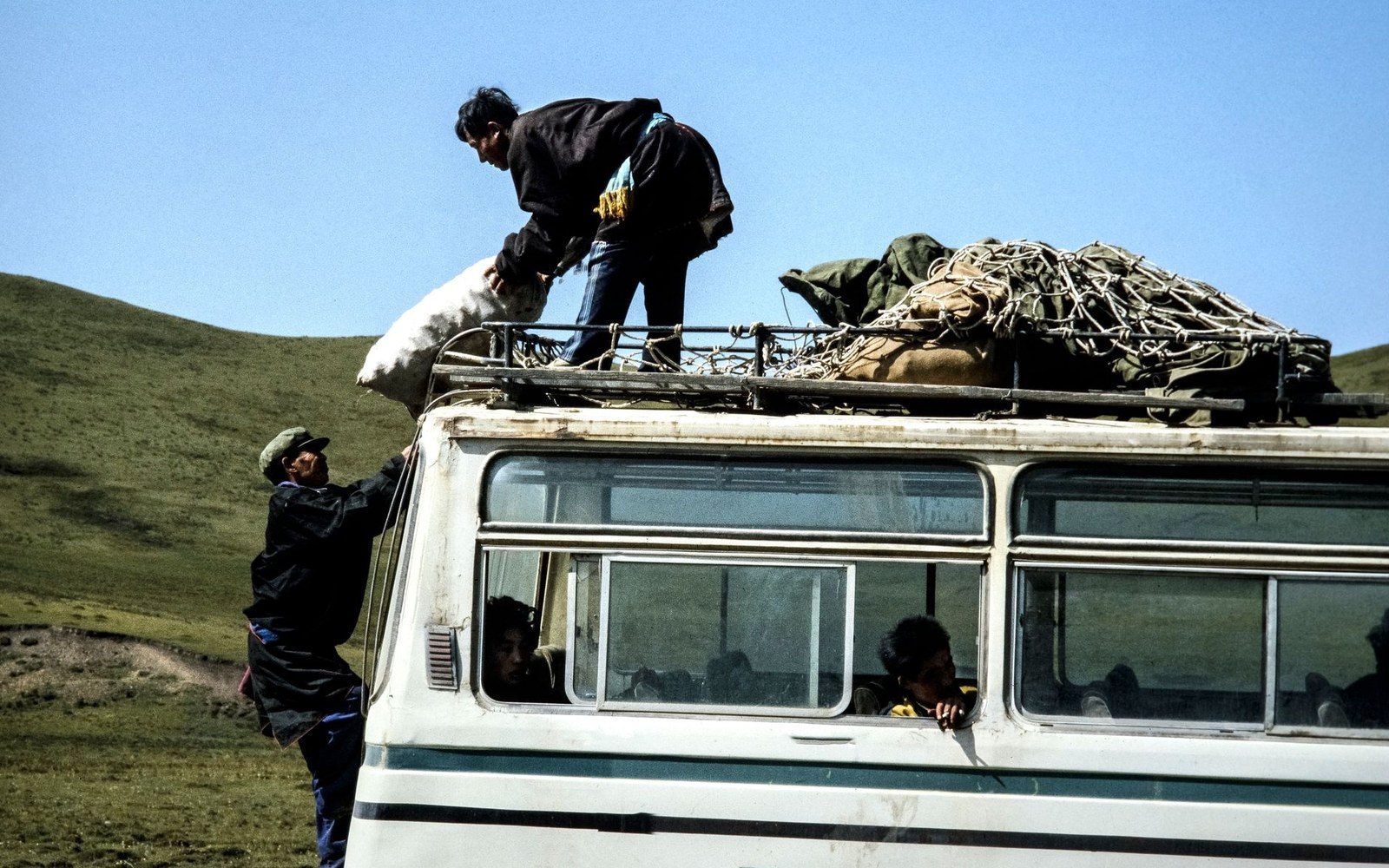
Luggage protocol varies. In most systems your bag goes on the roof rack or in the boot and is secured by the driver or a loader without consultation. Watch what happens to your bag; know where it is. At the destination things come off the roof quickly and the crowd disperses, so be ready.
The shared taxi is a remarkably efficient system once you surrender to its timing. It does not waste a journey on an empty seat; it does not leave until it can cover its costs. Every departure is, in this sense, a small negotiation that has reached agreement. You are one of the terms. When the engine starts and the car pulls into the road, the deal is done, the town is behind you, and the only remaining question is the road.