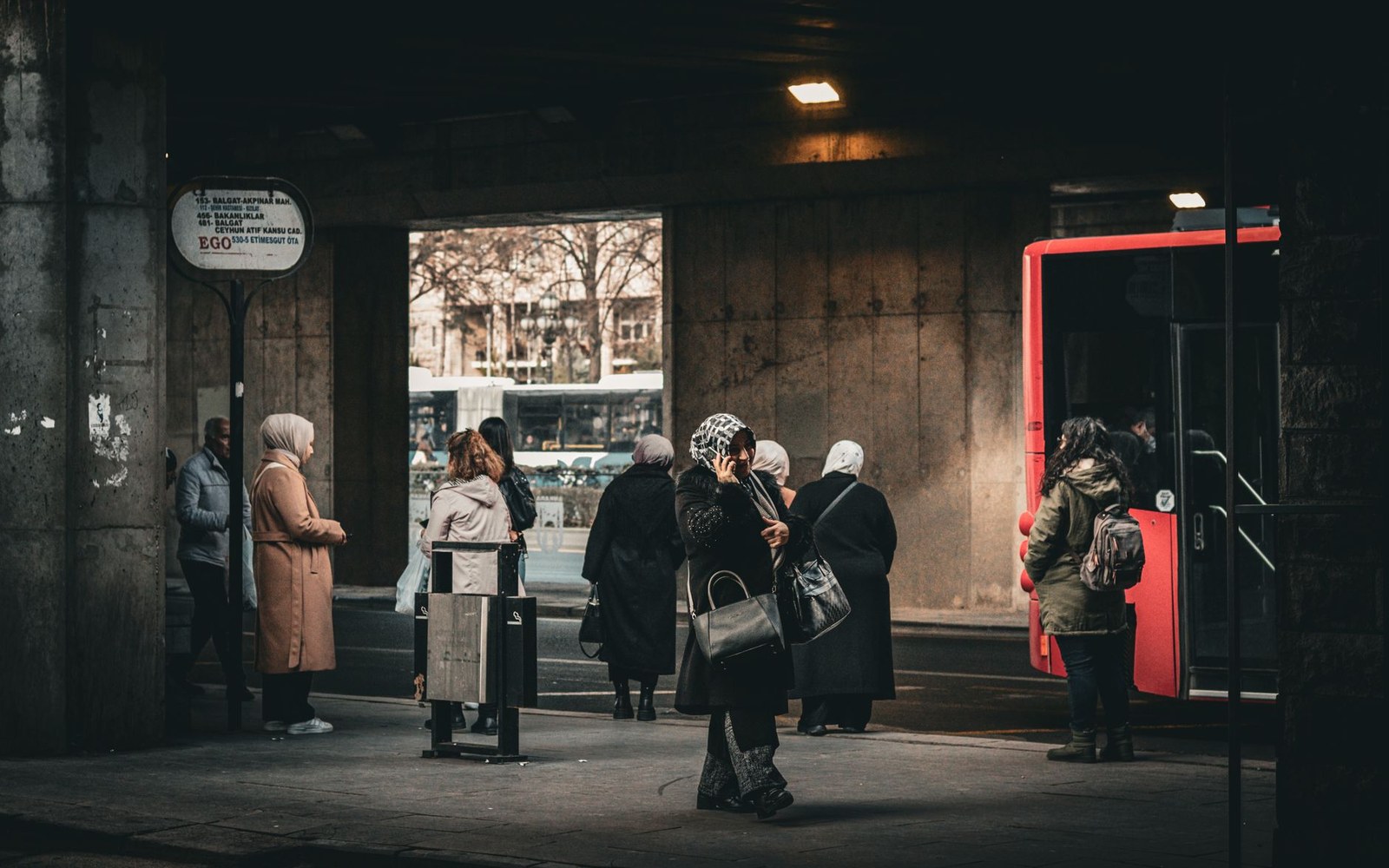
The station is already full when you arrive, and the light is the kind that makes everything look provisional — pale and flat, not quite committed to the day. A bank of fluorescent tubes holds the interior in a different timezone from the street outside, where the sky is beginning to sort itself out between grey and pink. In here, the hour is indeterminate. It could be any time at all.
The floor is concrete, good for sweeping, which someone is doing at one end with a wide broom, raising a thin layer of dust that settles immediately. Benches run the length of the walls. Half the seats are taken by people who have clearly been here for a while — a woman with a child asleep across her lap, two men with their heads back and their arms folded, a teenager awake and watchful, staring at nothing in particular.
The building is functional in the way that only buildings built to handle large numbers of strangers can be: a ticketing counter behind a scratched plastic screen, a chalkboard with departures in handwriting that varies by shift, a small room to one side selling things in plastic packaging. Tea, almost certainly. Bread, if you are lucky. The smell is of diesel and something faintly sweet — biscuits, maybe, or the cleaning fluid used on the floor.
What the hour produces
The 4am arrivals shuffle in from overnight buses, blinking. They sit down, look at their bags between their feet, and make no sudden movements. The body at that hour is conservative — it will not commit to being awake. A man transfers a sleeping child from his shoulder to a bench and the child does not stir. Someone finds a phone charger in a bag, follows the cord to the only free socket on the far wall, plugs in, and sits on the floor beneath it without a trace of self-consciousness. This is standard behaviour in a bus station at dawn; no one glances twice.
The departure side is livelier. A shared taxi tout moves through the room with the calm efficiency of someone who has done this ten thousand times. He names a destination, catches an eye or doesn't, moves on. A small cluster forms near the door to the platforms, strangers becoming a temporary unit — linked by the same destination and the same impatience, nothing else. They negotiate in the way that people who do not share a language negotiate: gesture, number, repetition, patience. It resolves. Someone pays. They go.
Vendors establish themselves just inside the entrance, where the passing traffic is highest. The transaction is fast and wordless — a coin, a wrapped thing, a nod. A boy of perhaps ten moves between the benches selling single cigarettes from a box, making his way methodically from one end of the hall to the other and back again. By the time the light outside shifts to something close to proper morning, he has done the circuit four times.
The hour turns
Somewhere between five and six, the station pivots. The overnight arrivals begin to disperse — they have been met, they have found their onward ride, they have simply decided that the floor is not where they want to be and have moved toward the street. The departure hall fills instead with people who have clearly slept somewhere reasonable and are starting a day rather than ending a night. They are louder. They have opinions about their luggage.
The chalkboard changes. A man in a green coat climbs a small stepladder, erases a destination with his sleeve, writes another in chalk. Two buses pull out in quick succession, and the platform briefly clears, and then a new crowd appears as if from nowhere, dragging sacks and boxes and one bicycle disassembled into its components and wrapped in cardboard.
The sweeper has finished. The fluorescent lights are still on, but now the windows are doing more work — the sun is low and deliberate across the concrete floor, and the hour is settled, the day committed.
You find a seat, put your bag between your feet, and wait.