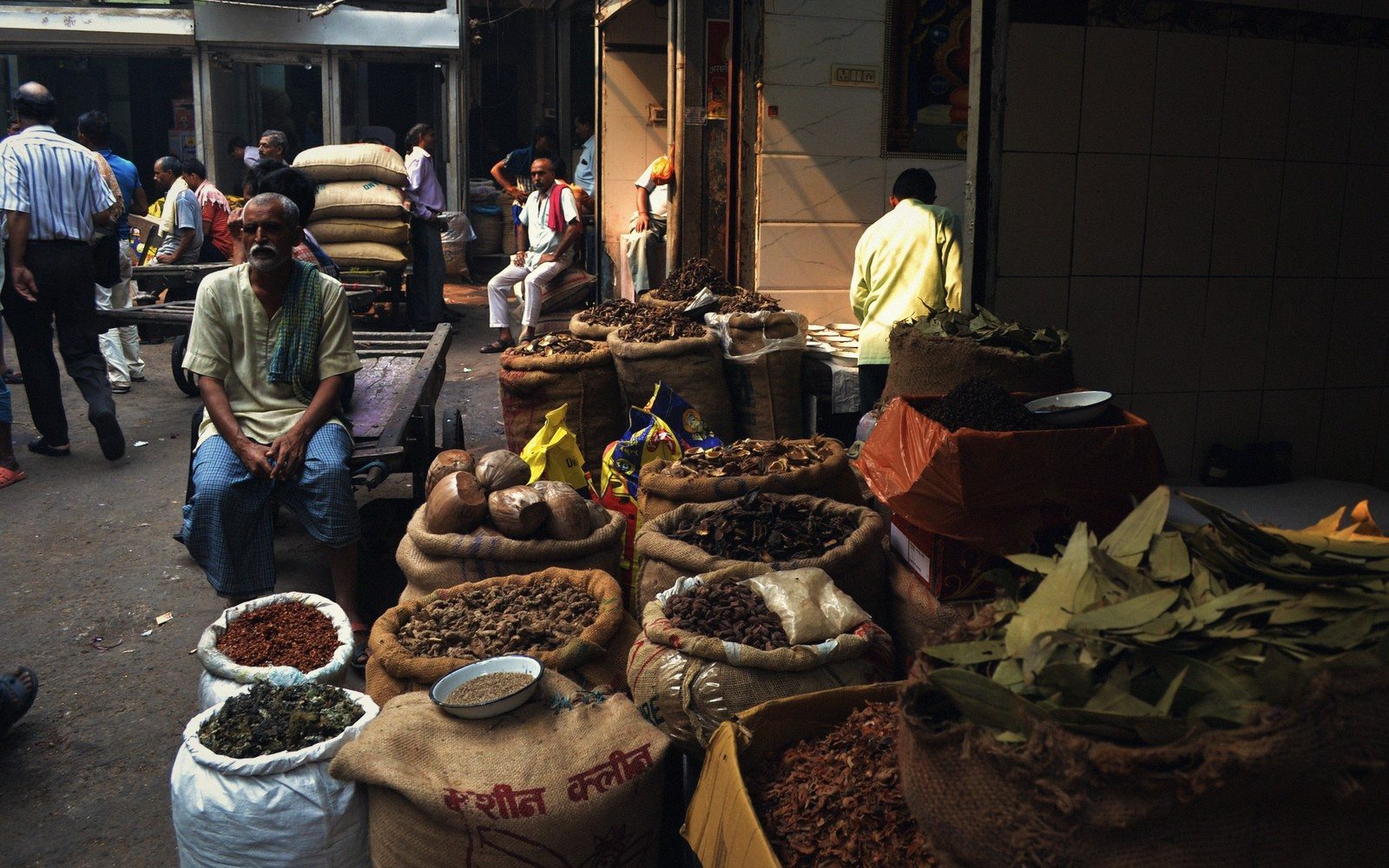
The morning market in a provincial Cambodian town opens before the light changes. Vendors arrive with their goods bundled into remorques — the small cargo trailers pulled by moto-dops — and by six the stalls are already deep with people. This is the psah, and it runs on Khmer Riel and a logic that rewards a few visits before you start spending.
Pick one stall: a woman selling dry goods in the covered hall, her table arrayed with small plastic bags clipped to a wire above and larger sacks open on the ground. The inventory reads like an archaeology of the region's trade routes. Dried fish from the Tonlé Sap. Fermented shrimp paste — prahok — produced in bulk along the lake's eastern shore and transported in sealed ceramic jars. Palm sugar cut from the toddy palms that line every road between Phnom Penh and Kampot, pressed into rounds and stacked in pyramids. Jasmine rice in ten-kilogram bags, grown in the floodplain provinces. Dried red chilies threaded on string, their origin somewhere in the northwest. The stall is, functionally, a map of the country compressed into about four square metres.
The price and what it measures
Most items are sold by the jong — a Cambodian unit roughly equivalent to 0.6 kilograms — or by the bag, which the vendor has already assembled to a price point that makes sense to the neighbourhood. A bag of dried fish might cost two or three thousand Riel, payable in either Riel or the US dollar equivalent; Cambodia's economy circulates both, and market arithmetic happens fluidly between them. The vendor does not use a calculator. She is running the conversions in her head, as she has done every morning for years.
The prices here are not the prices you will find quoted for tourists in the city. They are the prices a local schoolteacher or a remorque driver pays on the way to work. Not because sellers are trying to deceive visiting foreigners but because market economics are hyperlocal — the psah is calibrated to the purchasing power of the people who live nearby. If you are buying something you will actually carry and eat, prices are modest. If you are hesitating visibly and examining items with academic curiosity, they may shift. The distance between those two situations is mostly bearing.
A word on the plastic bags: everything small is double-bagged. Prahok in one bag, then another. Dried shrimp, same. The vendor has been watching the contents of her stall walk out in small portions all morning; the packaging is a craft. She will weigh, bag, tie and hand it across with the same efficiency whether you are buying the equivalent of forty cents or four dollars.
What travels and what doesn't
Some items at the stall have come a long way. The MSG packets — a fixture on every dry-goods table in the country — are typically manufactured in Vietnam or Thailand and distributed through regional wholesale networks that reach even small markets within a day or two by truck. Plastic condiment bottles bear Vietnamese text. The soy sauce may be Thai. Cambodian dry-goods trade has always been regionally porous, which is partly geography and partly the practical logic of a country that shares two long land borders with active manufacturing neighbours.
The things that have not come far are the best things: the prahok, the palm sugar, the dried fish. Local produce sold by the person who bought it directly from the producer, in a transaction two steps from the lake or the orchard. The fact that prahok smells powerful enough to clear a radius does not trouble anyone except newcomers. It is meant to smell like that. You will find it in everything worth eating.
The stall takes about forty-five minutes to shop properly. By the time you leave, the remorques are already filling up with the next round of deliveries.