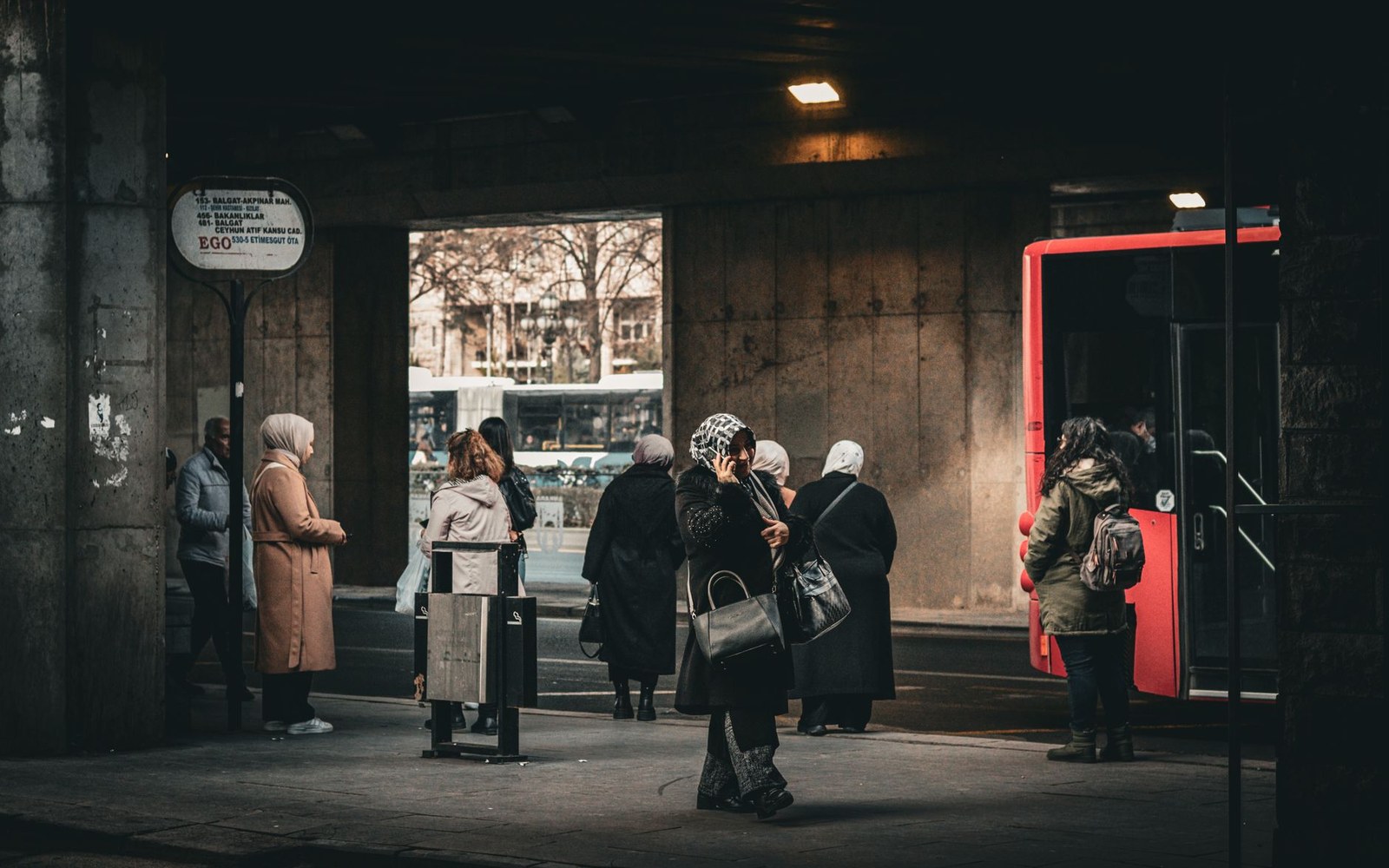
The guidebooks give you departure times and journey durations. They don't mention the six hours in between.
The Gap Is the Trip
There is a particular bench in every bus station in the world. It is made of wood or plastic or poured concrete, worn smooth by the weight of people who have been sitting on it since before you were born. You find it at dawn in Harare, mid-morning in Phnom Penh, at the dead hour of the afternoon in some unnamed town between La Paz and Potosí where the shared taxi has stopped because the driver wants coffee and nobody is asking why. You sit on this bench, or one very like it, and you wait.
Travel writing has always undersold this part. The prose rushes from border to city, from mountain pass to colonial square, the journey described as a vector — you were here, now you are there — with the hours between compressed into a single sentence about altitude or heat or the view through a dirty window. What gets left out is the bench, the coffee, the driver who has vanished, the hour that becomes two hours, the way the light changes while you are sitting still and the day reorganises itself around your stillness.
Nobody tells you that the waiting is the trip. Not a delay to it, not a tax levied on the interesting parts — the trip itself, continuous and alive, available to anyone patient enough to stop trying to skip it.
What Happens While You Wait
In practice, waiting looks like this. You have arrived at a bus station before the bus has. Or the bus is there but will not leave until it is full, and it is currently two passengers short of full, and those two passengers may appear in ten minutes or in two hours — the system does not say. This is the logic of the shared taxi: not a timetable but a threshold, and the world between your arrival and that threshold belongs to you completely.
What you do with it matters more than you expect. The traveller who spends it staring at a phone emerges from the wait unchanged, carrying only mild irritation and a depleted battery. The traveller who looks up finds something else: the tea being poured at the stall three metres to the left, the argument between two men that resolves, incomprehensibly from this distance, into laughter and a handshake, the child practicing a word in English and then running away when you respond. These are not profound moments. They are the texture of the day in a place that is not yours, and texture is what you came for, even if you would not have put it that way.
It happens in Kampot at a table outside a noodle shop, the river just visible between buildings, a long hour to fill before the bus north. It happens on the Kyrgyz side of a pass where Sary-Tash is visible in the valley below and the minibus driver is discussing something with a man in a different vehicle, the two of them unhurried, their conversation carrying none of the urgency you feel. You are cold. The view is extraordinary. The cold and the view are available to you in a way they would not be if the vehicle had kept moving.
In Sana'a once — in the old city, in a place where the streets narrow to the width of two people and the mudbrick towers have windows of alabaster that glow faintly even on an overcast day — a wait of indeterminate length outside a closed office produced two hours of aimless walking that would not have happened otherwise. The city gave itself up because there was time to receive it. That is what waiting does: it removes the itinerary as an excuse to stay shallow.
Learning to Be in One Place
The difficulty is not the boredom. Boredom, properly attended to, becomes something more interesting than boredom. The difficulty is the feeling that time is being taken from you rather than given. The wait is experienced as a subtraction — from the day, from the plan, from the total number of things you intended to see — rather than as the day being extended in a direction you hadn't considered.
This is a category error, and overland travel corrects it slowly and without your consent. A breakdown on a road outside Bulawayo, three hours of standing in dry grass while something mechanical is addressed, teaches the same lesson a philosophy course takes a semester to convey: the present is where you are, and making it somewhere else requires no transport at all, only a shift of attention. What happens around a breakdown — who stops, what is said, the ingenuity brought to a problem with limited tools — is not an inconvenience interrupting the journey. It is the journey, at its most direct.
The night bus version of this is more austere. You have surrendered the pretence of seeing anything. The dark outside the window is total, the seat is not designed for sleep, and you will arrive somewhere at an hour when the town has not yet decided to be awake. But the night bus is its own kind of waiting room — contained, stripped down — and the arrival it delivers, blinking and stiff into a cold bus station at four in the morning, places you in the day at a point of unusual openness. You have not planned the next hour because planning the next hour at that time would be absurd. Things happen to you instead of being managed by you, and this turns out to be the more interesting way to travel.
The Reward of Not Skipping It
There is a version of travel that fills every gap. Booked connections, confirmed onward tickets, the hour accounted for as transit rather than experienced as time. This version is efficient and produces a clean itinerary. It also produces a kind of travel that could be summarised in a spreadsheet: places visited, things seen, duration of stay. The waiting — with its bench and its bench's history, its tea and its driver and its child practicing English — has been successfully avoided.
What has also been avoided: the conversation that starts because you have been sitting in the same place long enough to seem unthreatening. The meal that exists only at one stall in one market and would not have been found without the accidental wandering that a two-hour wait in Aleppo or Lagos or Bishkek makes possible. The slowdown that allows a place to become specific rather than generic, this city rather than a city.
The overland traveller who has been moving for weeks or months knows the wait by its real name: research. Not the kind conducted with a device, but the kind conducted by presence over time, which is the only kind that actually tells you anything. You learn a place by being in it at the wrong time, when nothing is scheduled to happen, which is when it reveals what it is actually like rather than what it has arranged to show visitors.
The bench in the bus station, worn smooth by everyone who has ever sat on it — that bench has absorbed more of the place than any monument. Sit on it long enough and some of that understanding transfers. Not through any mystical process, just through time: the time the guidebook cut and the bus schedule skipped and the itinerary ignored, the time that was actually the trip.